
A photograph resurfaced this week that made me smile. A Premier League defender, by a pool in Spain, was completely baffled, watching me produce a playing card from behind his ear.
For the Crystal Palace squad in the early 2000s, that was a fairly ordinary afternoon. I have been a magician since the age of twelve, and the cards followed me through every dressing room I ever worked in. But the cards were never the point. They were a way in. A way of relating to people, which, as Steve Coppell once put it, mattered more than anything else I brought.
The real work was quieter, and it is the reason I still tell this story to boardrooms two decades on.
A club in survival mode
I joined Palace during a difficult stretch. The club had been in administration, it was fighting for survival, and the managers, Steve Coppell and later Alan Smith, were looking for any edge they could find.
We tried the obvious levers first. We changed the diet. Marginal. We changed the fitness routines. Marginal again. Everyone in the league was doing roughly the same things, so doing them slightly better moved the needle only slightly.
Then we changed the psychology, and the atmosphere shifted in a way the other changes never had.
I want to be careful here, because it would be easy to dress this up as something more heroic than it was. We did not win the league. What we did was steady a club through a frightening period and lay foundations that outlasted all of us. The interesting part is how, and that part does transfer.
The exercise I have used in every team since
One small intervention has stayed with me my entire career. I asked every player to write down three strengths of each of their teammates.
Take Bobby Zamora, who I worked with at Brighton. Ask most people for his strengths, and you get “good finisher, good in the air,” and they stop. Two answers, maybe three, and they are always the obvious football ones. But once the whole squad had contributed, Zamora ended up with something closer to fifty distinct strengths. Resilient. Bounces back. Great around the dressing room. Calms younger players down. None of these shows up on a stats sheet, and almost none of them had ever been said out loud.
We printed them onto posters and put them up around the training ground and the main stadium. So every time a player walked in, he passed a peer review of himself at his best, written not by a coach or a consultant but by the people he played alongside.
The most common reaction was a version of: “I did not even realise that was a strength of mine.”
That sentence is the whole thing. People rarely have an accurate picture of their own value to a group, because the qualities others rely on most are often invisible to the person who provides them.
Why it works, and what it is actually called
At the time, I was working on instinct. Years later, I learned there is a substantial body of research describing more or less exactly what we had stumbled into.
The closest formal version is the Reflected Best Self work developed by researchers at the University of Michigan, which involves systematically gathering feedback from the people around you about the moments when you are at your most effective, then using that composite picture to build a more accurate and more confident self-concept. It sits within the broader strengths-based tradition in psychology, the same tradition Martin Seligman helped move from the margins to the mainstream: the simple but underused idea that you get further by identifying and amplifying what people already do well than by endlessly auditing what they do badly.
The mechanism matters. When a strength is named by your peers rather than asserted by yourself, three things happen. It carries credibility because it comes from people with nothing to gain. It becomes shared knowledge, so the team starts deliberately using the strength it has now noticed. And it raises the individual’s belief that they belong and contribute, which is one of the most reliable predictors of how someone performs under pressure.
A poster on a wall is not the culture. Culture is the language a team uses about each other, made visible, specific, and shared. The poster is just where that language happened to live.
Psychology is not the fourth pillar
This is the argument I have built a career around, and the Palace story is where it began.
The standard performance model in sport sets out four pillars: technical, tactical, physical and psychological. Psychology almost always comes last on that list, treated as the thing you bring in when there is a problem. The fitness coach can say, “Ease up today,” and everyone nods. Psychology gets called only when something has already gone wrong.
I think that ordering is backwards. Psychology is not the fourth pillar standing alongside the other three. It is the foundation the other three are built on. Technical skill, tactical understanding and physical conditioning all express themselves through a mind that is either steady or scrambled when it matters most. Get the foundation right and the three pillars on top of it stand up under load. Ignore it, and they wobble at exactly the moment you need them.
That reframing is not a metaphor for football. It is just as true for a sales team in the final week of a quarter, a leadership group steering through a restructure, or any group of talented individuals who have to perform as one when the pressure is on.
The same principles, a different shirt
Twenty years on, I take this thinking into organisations through two keynotes.
Inside Winning Teams looks at what actually turns a collection of capable individuals into a team that performs together, the culture work underneath the results.
The Winning Mind looks at the individual side: how people hold their nerve and deliver when the big points arrive.
If you lead people, culture or internal communications, the Zamora exercise is yours to borrow. Ask your team to name three strengths in each of their colleagues, then make the answers visible. It costs nothing, and it tells you and them something most performance reviews never will.
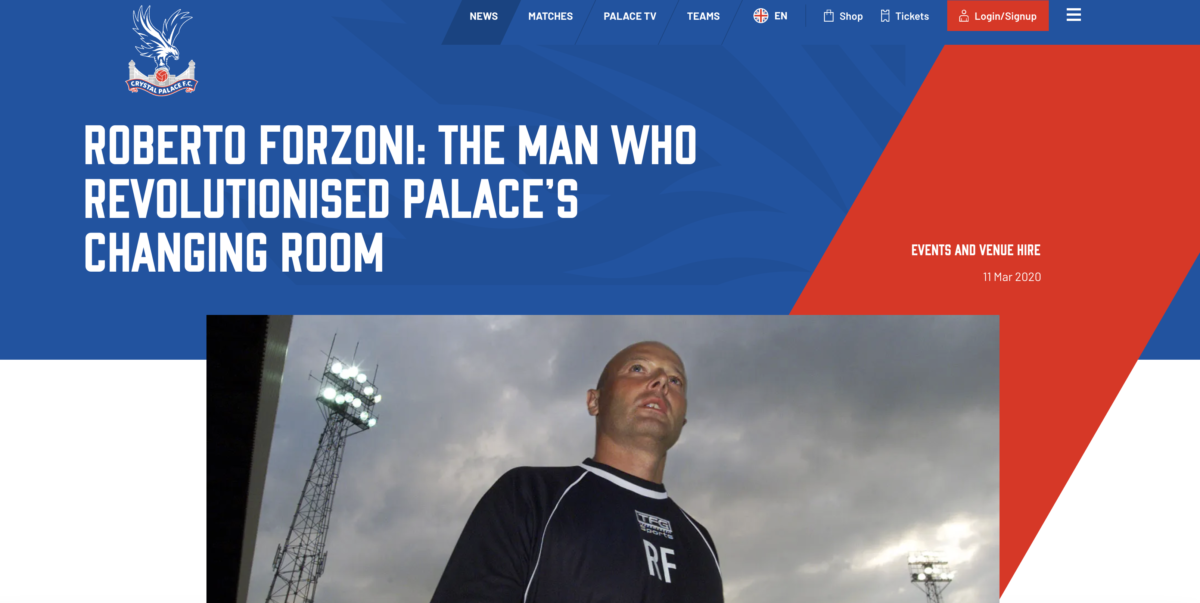
Crystal Palace published their own account of those years, including Steve Coppell’s recollections, which is generous of them and worth a read: The man who revolutionised Palace’s changing room.
The cards, for the record, still come out occasionally. Coppell once told me that ninety-nine ideas in a hundred would go straight in the bin, but to keep bringing them anyway, because the hundredth might change everything. I have taken that as a working philosophy ever since.
Roberto Forzoni is a performance psychologist, keynote speaker and member of the Magic Circle, with four decades of experience across elite sport. To enquire about a keynote, check availability here.