
And how athletes, leaders – and even speakers – can hold their nerve
Roberto Forzoni • Performance Psychologist
The most painful sight in sport
There are very few non-life-threatening situations in which the suffering of a stranger causes you genuine pain. Watching an elite athlete choke is one of them.
You can see it happening in real time. Poise gives way to cinder-block feet. Intelligence is replaced by tunnel vision. The technique that has held up under thousands of repetitions suddenly seems to have packed its bags and gone home. The athlete knows what to do. They desperately want to do it. And, somehow, they can’t.
It is uncomfortable to watch, partly because we know, deep down, that it is not really about them. It is about us. We have all stood at our own version of that tee-shot, presentation slide, or three-foot putt – and felt our hands turn into ham. Choking is one of the most universal human experiences in performance. Which is why, every time it happens to someone famous, we look away through our fingers and quietly think:
“There but for the grace of God…”
Then we change the channel.
What “choking” actually is
The most rigorous working definition comes from cognitive scientist Sian Beilock (now President of Dartmouth College and author of Choke: What the Secrets of the Brain Reveal About Getting It Right When You Have To). She defines it simply:
“Choking is performing worse than expected, given your skill level, because of the situation and its consequences.” — Sian Beilock
That last clause is critical. Choking is not the same as nerves, lack of ability, an off-day, or being beaten by someone better. It is a very specific failure: a performance that falls noticeably below what the athlete has shown, repeatedly, that they can produce – and the cause is the moment, not the task.
The hallmarks are:
- A familiar, well-rehearsed task (a putt, a serve, a penalty, a key sentence in a speech).
- High perceived stakes – reputation, money, identity, who-you-are-to-other-people.
- Performance that is not just poor, but inferior to the performer’s own established standard.
Choking, in other words, is a brain glitch under pressure. And once you understand what is actually going on inside the head, it becomes much easier to prevent.
What is happening in the brain
Around fifty years of sport-psychology research has converged on two main families of explanation. They are not mutually exclusive – most chokes contain elements of both – but they explain different parts of the puzzle.
1. Distraction theory: the mental hijack
First proposed by Wine (1971) and developed by Carver & Scheier and others, distraction theory holds that choking occurs when attention is hijacked from the task to task-irrelevant noise: worry, consequences, the scoreboard, what your father-in-law will say at Christmas dinner.
Think of it like your Wi-Fi. There is a certain amount of bandwidth available, and that’s it. The more of it you use up streaming irrelevant things – “What if I miss?”, “What will the press write?”, “Don’t blow it” – the less is left for the thing you’re trying to do. Working memory works the same way: limited capacity, easily clogged. Fill it with consequence-thinking, and there is simply no bandwidth left for the task.
This is why distraction-driven choking shows up most strongly in cognitively demanding tasks: mathematics under exam pressure, decision-rich sports like quarterbacking or batting, complex tactical adjustments. As I described it in an earlier interview – and still believe – it is a thought process: “Rather than thinking about what you do, you think about the consequence.”
2. Self-focus theory: paralysis by analysis
The second mechanism is almost the opposite – and arguably more dangerous, because it disproportionately affects the very best performers. Pioneered by Baumeister (1984) and refined extensively by Beilock & Carr (2001) and Rich Masters’ Reinvestment Theory, it goes like this:
Skilled performance is largely automatic. A professional golfer does not consciously think about wrist angle, weight transfer, or follow-through any more than you consciously think about how to walk downstairs. Years of practice have moved the skill into procedural memory, where it runs faster, smoother, and below the level of conscious awareness.
Under pressure, the prefrontal cortex – the bit of the brain that handles deliberate, conscious control – tries to “help”. It steps in and starts micro-managing what was happily running on autopilot. Beilock’s phrase for this is perfect:
“Paralysis by analysis.” — Sian Beilock
Beilock’s lab studies are striking. When she asked college soccer players to dribble while focusing on which side of their foot was contacting the ball, they got slower and made more mistakes. When she put expert golfers on a putting green and asked them to consciously monitor their stroke mechanics, they missed more putts than novices. The very thing that makes you world-class – fluid, automatic execution – is what conscious control disrupts.
This is why the cruellest chokes in sport tend to involve fine-motor skills under extreme scrutiny: short putts, free throws, penalty kicks, conversions in front of the posts. The skill is hyper-automatic. Conscious interference is fatal.
3. Attentional Control Theory: anxiety eats working memory
A more recent integrative model, Attentional Control Theory (Eysenck and colleagues, 2007), explains how the two mechanisms above are linked. Anxiety, the theory argues, doesn’t just make us feel bad; it actively impairs the brain’s ability to inhibit distractions and to switch attention flexibly. The result: more rumination, less ability to refocus, and a higher chance of either of the failure modes above.
4. The arousal–performance curve (and where it breaks)
The classic Yerkes–Dodson inverted-U suggests that performance rises with arousal up to an optimum and then falls. It is broadly correct but too neat. Hardy & Fazey’s Catastrophe Model updated it: when cognitive anxiety is also high, the descent past the optimum is not gentle. It is a cliff. Performance does not decline politely; it falls off the edge. Choking is the catastrophe.
In short: physical arousal alone is not the enemy. The combination of high arousal and high cognitive worry is what topples a performance off the cliff.
A short Hall of Fame
Theory is one thing. Watching a Hall-of-Fame athlete come unstuck in slow motion is another. Below are seven case studies that illustrate the different flavours of choking – and, if we are honest, contain the kind of dark comedy that makes them unforgettable.
Greg Norman, 1996 Masters
The Great White Shark went into the final round at Augusta with a six-shot lead over Nick Faldo. He had opened the tournament with a record-tying 63. Six shots is a barricade, not a lead.
Norman shot 78. Faldo shot 67. The Australian ended up losing by five, an eleven-shot swing across one round. Sport psychologist Rick Jensen later got him to admit that the night before, he had told himself: “I don’t know if I can hold it.” He didn’t sleep.
On the first tee he hooked his drive into the trees. By the ninth he was visibly gripping and re-gripping the club, as if it were suddenly an unfamiliar object. Faldo, with a touch of grace very rare in elite sport, embraced him on the 18th green and said: “I don’t know what to say to you. I just want to give you a hug.” Norman’s own post-round assessment was less diplomatic and largely unprintable.
What it shows: The textbook overnight rumination. Distraction theory in action – a mind so full of consequence that there was no room left for the swing.
Jean Van de Velde, 1999 Open Championship, Carnoustie
Possibly the most absurdly funny choke ever broadcast – funny only because Van de Velde himself has handled it with such grace ever since.
The Frenchman stood on the 18th tee at Carnoustie with a three-shot lead. He needed a double-bogey six to win the Claret Jug – the kind of margin that lets you putt up the fairway with a sand wedge. Instead, he pulled the driver. The shot drifted onto the 17th fairway. His second cleared the first stretch of the Barry Burn but ricocheted off a grandstand railing back into deep rough. His third dropped, with biblical inevitability, into the burn.
Then came the moment that no choke compendium can omit. Van de Velde took off his shoes and socks, rolled up his trousers, and waded into the water to consider whether he could play the ball as it lay. The BBC’s Peter Alliss, somewhere between disbelief and grief, intoned: “Will somebody kindly go and stop this?”
Eventually he chipped on, drained an eight-foot putt for a triple-bogey seven, and forced his way into a play-off, which Paul Lawrie won. Van de Velde, to his eternal credit, has spent the last quarter-century discussing the episode with humour and a very Gallic shrug. “It never haunted me,” he says.
What it shows: Self-focus theory mid-implosion. A player who had been swashbuckling all week suddenly trying to manage the situation rather than play golf, and a textbook collapse in decision-making once the cliff had been reached.
Jana Novotna, 1993 Wimbledon final
Novotna led Steffi Graf 4–1 in the final set, with a break point for 5–1. Two games later she had a double-fault, missed an easy volley and dropped serve. From there she lost five games in a row and the match.
What followed has become one of sport’s most poignant images: the runners-up trophy presentation, where the Duchess of Kent gave the sobbing Novotna a hug on Centre Court that lasted an unforgettably long time. Novotna eventually won the title in 1998. The hug arguably did her more long-term good than any sport-psychology session could have.
What it shows: Distraction in its purest form: a player suddenly aware of being one game from immortality, and unable to play the next point as a point.
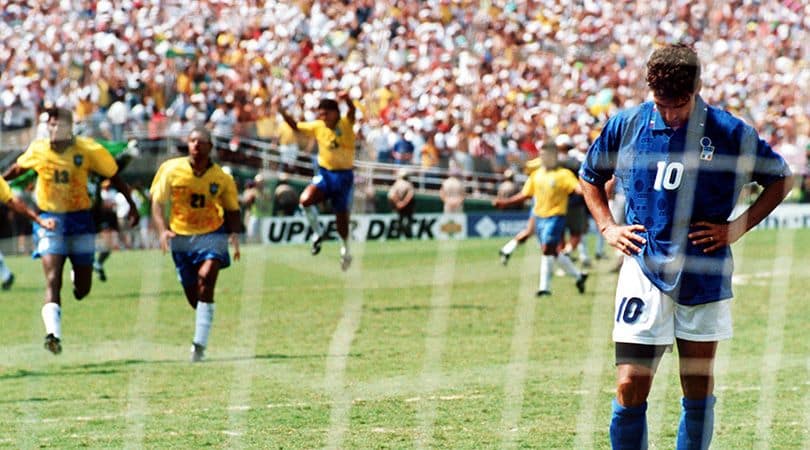
Roberto Baggio, 1994 World Cup Final penalty
Italy versus Brazil. Penalty shoot-out. The most talented Italian footballer of his generation steps up to the spot, the entire World Cup riding on his foot. He blasts the ball over the bar.
Baggio later said something that every choking athlete will recognise: “I failed that time. Period. And it affected me for years. It is the worst moment of my career. I still dream about it.”
What it shows: A textbook self-focus failure on a hyper-rehearsed automatic skill. He had taken thousands of penalties. He almost certainly stopped trusting one of them.
Doug Sanders, 1970 Open at St Andrews
Sanders had a three-foot putt to win The Open. Three feet. The kind of putt a tour pro makes in their sleep.
He missed it. He lost the play-off the next day to Jack Nicklaus. Asked years later whether he still thought about it, Sanders replied with a line that should be on every performance psychologist’s wall: “Sometimes I go five whole minutes without thinking about it.”
Devon Loch, 1956 Grand National
A horse, granted, but worth a paragraph because it is the most surreal example on the list. The Queen Mother’s horse Devon Loch was strolling clear forty yards from the finish line at Aintree, ten lengths ahead, when it suddenly belly-flopped onto the turf for no obvious reason. Theories abound: a phantom jump, a sudden noise, cramp. Whatever it was, the term “doing a Devon Loch” entered British English to describe collapsing within sight of victory.
What it shows: That the cliff-edge nature of pressure-failure is not exclusively human. Even instinct can fail when the moment is too big. (Or perhaps, charitably, that horses don’t read the script.)
Tim Henman, 2001 Wimbledon semi-final
Henman led Goran Ivanisevic two sets to one and was, in the considered opinion of much of England, about to reach his first Wimbledon final. The match was suspended overnight by rain. Henman never recovered. He was a different player when he came back, and he has been honest about it since: he had spent the night thinking about the final, not about the next set.
What it shows: Distraction and overnight rumination, magnified by an unwanted interruption. The exact mechanism that did Norman in five years earlier. Pressure does not need a stadium; it just needs a long, quiet hotel room.
It happens to all of us
Choking is not the exclusive property of millionaires in white shorts. The exact same mechanism explains:
- The wedding speech that goes well in the shaving mirror and falls apart in the marquee.
- The driving test where you suddenly forget which pedal is which.
- The job interview answer that was beautifully crafted on the train emerges in the room as a series of unrelated nouns.
- The penalty kick at five-a-side. The stage fright that hits at the karaoke microphone. The blank screen halfway through your big presentation to the board.
Beilock makes this point repeatedly: the same neural patterns underlie a missed three-foot putt and a lost train of thought in front of an audience. As the NPR write-up of her work put it: “for every spectacular performance in sports history, there’s an example of a highly-skilled athlete who folds under pressure. And it’s not just sports: we also might freeze up during a presentation, an important recital or a big speech.”
Which means – and this is the good news – the strategies that work for elite athletes work for the rest of us too.
The expertise paradox
There is a puzzling pattern in the research: in some types of tasks, the more skilled you are, the more vulnerable you become to choking.
It sounds counterintuitive, but it follows directly from self-focus theory. A novice golfer is barely keeping the ball on the planet. They have no smooth, automated swing for conscious attention to interfere with. An expert, by contrast, has spent twenty years building a beautifully grooved, unconscious motor programme. When pressure forces them into deliberate, step-by-step monitoring, they have a long way to fall.
Masters’ Reinvestment Theory captures this elegantly: under pressure, performers “reinvest” conscious attention back into a skill that has long since outgrown the need for it – with predictable results.
This is also why the cure is sometimes “less thinking, not more.” Beilock has shown that experienced golfers who are given a simple distractor task – humming a tune, focusing on a single external cue – actually putt better under pressure than those told to concentrate on technique. The conscious mind, like an over-eager assistant, is best given something useful but irrelevant to do, so it stops trying to do your job for you.
A close cousin: self-handicapping
Worth a quick detour, because it sits very close to choking and is often mistaken for it.
Self-handicapping is the (largely unconscious) act of building yourself an excuse before the event has even started. The hamstring you start rubbing on the changeover. The “I didn’t prepare much for this one” you tell colleagues before the big presentation. The illness, the stiff back, the tactical complaint to the umpire.
It is psychologically protective – if you fail, you can blame the handicap rather than yourself – but it is performance-corrosive. I’ve seen it close up at the very top: when Andy Murray was a young player, one of the things we worked on was eliminating it. He used to rub his ankle or his back when things went wrong. The opponent reads that the same way a shark reads blood: I’ve got him. Andy deliberately decided to stop, even if it really did hurt. As he later put it himself:
“Working with Roberto, I’ve learnt to appreciate tennis again. I was getting angry on court about things that weren’t necessary.” — Andy Murray
Removing the self-handicap removed half the ammunition for choking. The other half is what comes next.
How to stop choking: ten evidence-based strategies
No single tool works for everyone. But the literature – and twenty-five years of practical work in dressing rooms, coaching boxes and on tennis courts – converges on a set of strategies that genuinely make a difference. Most of them work just as well at the lectern as at the foul line.
1. Control the controllables
The single most-quoted line in performance psychology, and for good reason. You cannot control the scoreboard, the weather, the audience’s mood, or what your opponent had for breakfast. You can control your preparation, your routine, your next decision and your effort.
Players who fixate on outcome (“I must win this point”) consistently underperform players who fixate on process (“I must execute this serve”). The same is true of speakers: the audience is not your job, your message is.
2. Reframe the arousal: anxiety as excitement
One of the most useful pieces of recent research is Alison Wood Brooks’ (2014) work at Harvard. Brooks compared three groups about to do a stressful task: one was told to calm down, one was told to feel anxious, and one was told to feel excited. The reframing group consistently performed better at public speaking, maths, and karaoke (yes, really).
The reason is biological. Anxiety and excitement are physiologically almost identical: high arousal, racing heart, alert focus. The body cannot tell the difference. The label you put on it is what changes everything. “Calm down” fights your physiology; “get excited” works with it. Jeremy Jamieson’s parallel research on stress reappraisal in students taking maths exams found the same effect: students who were taught to interpret their racing hearts as fuel for performance, rather than as signs of impending doom, scored better.
The line I give athletes and speakers to say to themselves before they go on:
“My body is preparing me. This is fuel.”
3. External, single-cue focus
Research on the quiet eye (Joan Vickers, University of British Columbia) shows that elite performers in target sports fixate longer on a single external cue immediately before action than non-elite performers do. Their gaze settles, they trust the body, they pull the trigger.
The practical version of this is to give yourself one external cue and one verbal cue. Not technique. Not outcome. Just a single anchor: the back of the ball, a spot on the target, the fingernail of the back hand. Anything that occupies the conscious mind without trying to drive the bus.
4. Pre-performance routines
Watch any elite performer. Rafa Nadal’s towel, water-bottle alignment and shorts-tug. Jonny Wilkinson’s pre-kick stillness. Steve Jobs’ rehearsed entrance to a keynote. These are not superstition; they are deliberate cognitive scaffolding.
A good pre-performance routine has three jobs:
- Anchor attention on a familiar set of cues, crowding out task-irrelevant noise.
- Trigger the same physiological state every time, so the body knows what is coming.
- Mark a clear boundary between “ordinary life” and “performance state”.
For a speaker: the routine might be – same shoes, same warm-up, same first sip of water, same first sentence memorised cold. The first thirty seconds should be so over-rehearsed that you could deliver them concussed. By the time autopilot wears off, you are already on stage and warmed up.
5. Implementation intentions: the if–then plan
Peter Gollwitzer’s research on implementation intentions has shown, in dozens of studies, that pre-deciding your response to specific situations dramatically improves follow-through under stress. The format is simple: If X happens, then I will do Y.
- If I notice my mind drifting to the score, I will reset on my breath and the back of the ball.
- If I forget a line in the speech, I will pause, drink water and pick up at the next bullet.
- If I miss the first serve, I will exhale, bounce twice and trust the second.
Pre-loaded decisions short-circuit panic. The brain doesn’t need to think under pressure; it just needs to recognise the situation.
6. Acclimatisation: train under pressure
You cannot rehearse pressure into existence on the day. You have to manufacture it deliberately in training so the body is no longer surprised by it.
Goalkeepers practising penalties with team-mates watching and money on the line. Speakers running their material in front of one mildly hostile colleague before they ever take it to a paying audience. Pianists performing in front of a single judge before the recital. The neuroscience here is straightforward: the more often the body experiences high arousal coupled with successful execution, the less it interprets the next dose of arousal as a threat.
This is partly why British tennis players have historically struggled. The domestic competitive environment is too gentle. Players who go to Spain or Florida to train are constantly under pressure. They get used to it long before the Centre Court crowd arrives.
7. Use the body to slow the mind
A racing mind cannot be argued out of racing. It can, however, be slowed down by the body.
The most reliable tool is the physiological sigh – a double inhale through the nose followed by a long exhale through the mouth. It activates the parasympathetic nervous system within seconds and is the single fastest way to bring heart rate and arousal down on demand. Two of these, before walking on stage, between points, or before the next big shot, will do more than ten minutes of trying to think positively.
8. Distract the conscious mind – deliberately
Counter-intuitive but well-established: for highly automatic skills under pressure, a mild conscious distractor can outperform focused concentration. Beilock’s golfers putted better while humming a tune than while monitoring their stroke.
This is why some elite performers count their breaths during competition. Why do others use quiet self-talk words in a foreign language? Why a singer hums a separate tune in their head between phrases. The conscious mind is given a small, harmless job. The expert system, freed from interference, gets on with the actual work.
9. Reduce the apparent stakes
Choking is driven by perceived consequence. Anything that reduces the perceived stakes – without reducing your effort – helps.
Two reframes that work consistently:
- Process over outcome: “I cannot affect whether I win. I can affect this next ball.”
- Long-view perspective: “In five years, this point will be a footnote.” Andy Murray’s “progress of success” mindset – the idea that any single match is a data point in a much longer trajectory – was a deliberate antidote to the catastrophising induced by Grand Slam finals.
10. Bounce-back routines
Even the best choke sometimes. The difference is what happens next. Federer was famous for forgetting a missed point in seconds. Murray, after the public tears of the 2012 Wimbledon final, won Olympic gold in the same building eight weeks later and his first Grand Slam at the US Open shortly after that.
Worth pausing on a distinction that audiences almost always get wrong: emoting under pressure and choking under pressure are not the same thing. John McEnroe constantly blew up on court. Andy Murray, in his early years, was famously volatile too. Both kept winning. What made them elite wasn’t suppressing emotion – it was reset speed.
People watching McEnroe smash a racket used to think, “That’s fine, I can do that.” What they didn’t have was his ability to get right back to the next point. The choke isn’t the outburst. The choke is when the outburst is still there four games later.
This matters at work too. “Stay calm” is not actually the goal – recover fast is. The cost of a frustration spike in a meeting isn’t the spike itself; it’s the half-hour of compromised decision-making that follows it. As I once said about Murray, possibly more dryly than was warranted: “I’ve got to say, when he doesn’t do it, he plays better overall.”
A good bounce-back routine has three steps:
- Acknowledge: Yes, that happened. No denial.
- Reset: A physical cue – a deep breath, a tug on the shirt, a deliberate walk – that signals “next point”.
- Re-cue: Return to your single external focus and your next process goal.
It should take seconds, not minutes. Anything longer is the choke writing the next chapter.
A specific note for speakers
Public speaking is, for most people, the closest they come to the experience of an elite athlete on a big stage. The body responds the same way – racing heart, dry mouth, narrowing focus, butterflies. It is not a weakness. It is your nervous system getting ready to perform.
A handful of additional practical points specifically for the lectern:
- Memorise the first sixty seconds cold. Not the rest – just the opening. By the time autopilot fades, you are warmed up, and the audience has accepted you.
- Walk the room first. Familiarity is calming. Stand on the stage, see the lights, and stand where the lectern will be. Your nervous system stops treating it as a threat.
- Find one friendly face. Then a second, in a different part of the room, then a third. You speak to people, not to a wall.
- Slow down. Almost every speaker rushes when nervous. Deliberate pauses make you look authoritative and give your brain time to catch up.
- Have a recovery line. Pre-load one. “Let me say that again, properly” works in any context and is far more disarming than apologising.
And, if all else fails, take comfort in this: the audience overwhelmingly wants you to do well. Unlike Greg Norman’s Augusta gallery, they have not put 600 pounds on you for missing.
A final thought
Choking is not a character flaw. It is not a weakness. It is not a failure of will. It is a brain on the wrong setting at the worst possible moment – and the brain, helpfully, is a setting you can change.
The athletes I have worked with at the very top – in Premier League dressing rooms, on Centre Court, ringside in world-title fights, on Olympic start lines – are not people who never feel pressure. They are people who have built reliable ways to perform with it. So can the rest of us. So can the bride give the speech, the manager present to the board, the tennis player on the practice court at Roehampton, the candidate sitting outside the interview room?
The most useful sentence I know on the subject came from Sir Clive Woodward, in four words:
“Think correctly under pressure.” — Sir Clive Woodward
Choking is what happens when we don’t. Performance is what happens when we do. The good news is, that is a skill – and skills are trainable.
And if you ever find yourself, ankle-deep in a Scottish burn, considering whether to play it as it lies… take the drop.
Selected references
Baumeister, R. F. (1984). Choking under pressure: Self-consciousness and paradoxical effects of incentives on skilful performance. Journal of Personality and Social Psychology, 46(3), 610–620.
Beilock, S. L., & Carr, T. H. (2001). On the fragility of skilled performance: What governs choking under pressure? Journal of Experimental Psychology: General, 130(4), 701–725.
Beilock, S. L. (2010). Choke: What the secrets of the brain reveal about getting it right when you have to. Free Press.
Brooks, A. W. (2014). Get excited: Reappraising pre-performance anxiety as excitement. Journal of Experimental Psychology: General, 143(3), 1144–1158.
Eysenck, M. W., Derakshan, N., Santos, R., & Calvo, M. G. (2007). Anxiety and cognitive performance: Attentional control theory. Emotion, 7(2), 336–353.
Hardy, L., & Fazey, J. (1987). The inverted-U hypothesis: A catastrophe for sport psychology. North American Society for the Psychology of Sport and Physical Activity Conference.
Jamieson, J. P., Peters, B. J., Greenwood, E. J., & Altose, A. J. (2016). Reappraising stress arousal improves performance and reduces evaluation anxiety in classroom exam situations. Social Psychological and Personality Science, 7(6), 579–587.
Masters, R. S. W. (1992). Knowledge, knerves and know-how: The role of explicit versus implicit knowledge in the breakdown of a complex motor skill under pressure. British Journal of Psychology, 83(3), 343–358.
Vickers, J. N. (2007). Perception, cognition, and decision training: The quiet eye in action. Human Kinetics.
Wine, J. (1971). Test anxiety and direction of attention. Psychological Bulletin, 76(2), 92–104.